Toronto permit data
Building permits in unorganized townships: the Ontario exception
Published July 24, 2026
The short version
- Most unorganized townships have no municipal building department, so there is usually no local building permit to apply for.
- The Ontario Building Code still applies across the province. No permit does not mean no rules.
- Septic approvals, electrical inspections, and road entrance permissions still exist, issued by provincial bodies and local boards instead of a city hall.
- Skipping code compliance can surface later through insurance, financing, and resale, even if no inspector ever visits the site.
Do you need a building permit in an unorganized township in Ontario?
Short answer: Usually not, because there is no municipality to issue one. Unorganized townships have no building department, so there is no local permit office, no application, and no municipal inspector. The Ontario Building Code still applies to the work itself, and provincial approvals for things like septic systems and electrical work still exist. Confirm your situation with the Ministry of Municipal Affairs and Housing before building.
This is the one genuine exception in Ontario's permit system. Everywhere else in the province, a building permit is the gate you pass through before construction. In unorganized townships the gate is missing, but the road rules are not. This guide covers what an unorganized township actually is, what still applies when no permit exists, and why building to code anyway is the practical choice, not just the legal one.
What is an unorganized township?
An unorganized township is territory with no incorporated municipal government. No town council, no city hall, no bylaw office, no building department. The lowest level of government is the province itself. Almost all of Ontario's unorganized territory sits in the northern districts, places like Algoma, Sudbury, Timiskaming, Thunder Bay, Nipissing, and Kenora, along with pockets of the near north such as parts of Parry Sound district.
That does not mean nothing is organized at all. Many unorganized areas have a local services board that handles limited services like fire protection or emergency addressing, a local roads board that maintains roads, and in some areas a planning board that administers land-use rules. None of these is a municipality, and none of them issues building permits.
The contrast with a big city is stark. In Toronto, essentially every significant project runs through a building department, and the result is a public record: PermitIndex counts 28,514 building permits issued in Toronto in the trailing twelve months and currently on record as of Aug 26, 2026. In an unorganized township, the equivalent number is effectively zero, not because nobody builds, but because nobody issues the paper.
Does the Ontario Building Code still apply without a permit?
Yes. The Building Code sets construction standards for the whole province, and buildings in unorganized territory are expected to comply with it even though no permit is issued. The absence of a permit is an absence of local administration, not an exemption from the rules.
Quotable: In an unorganized township the permit disappears but the code does not. Ontario's Building Code applies across the province, whether or not there is anyone nearby to issue a permit or inspect the work.
Enforcement in territory without municipal organization is the responsibility of the Ministry of Municipal Affairs and Housing. In 2023, through Bill 97, the province gave itself the additional option of appointing qualified people or entities as building inspectors for unorganized territories, a sign that the era of zero oversight is not guaranteed to last. Provincial guidance also directs builders in unorganized areas to contact the ministry before construction, and in some cases to obtain a letter of conformity confirming the project meets applicable requirements. The current process is described on the province's regulatory roles page, and it is worth a call to the nearest municipal services office before you pour a footing.
In practice, inspection is far lighter than in any city. That shifts the burden onto you: the person who certifies the work in an unorganized township is, functionally, the owner.
Which approvals do you still need?
No building permit does not mean no approvals. A typical build in an unorganized township still touches most of the following, each from a different body. Requirements vary by district, so treat this as a checklist to confirm, not a final answer.
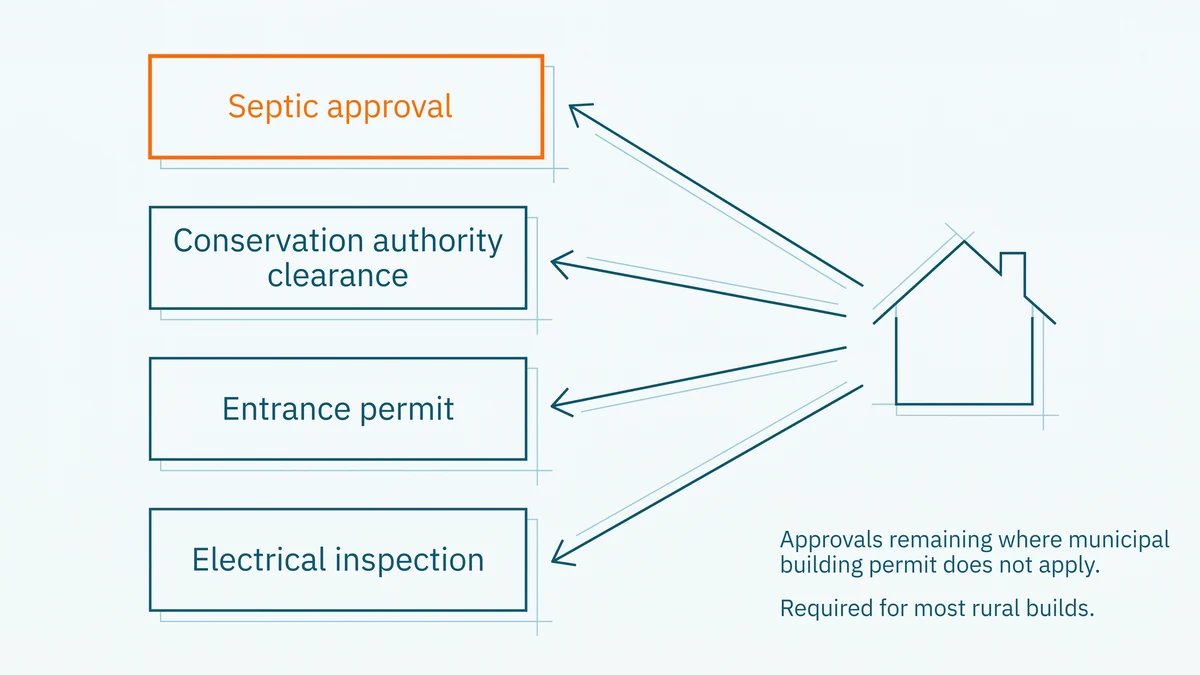
- Septic system. On-site sewage systems fall under the Building Code, and in unorganized areas the approval authority is typically a health unit or conservation authority rather than a municipal office. A new or replacement system generally needs its approval before installation.
- Electrical work. Ontario's Electrical Safety Code applies province-wide, and electrical installations are handled through the Electrical Safety Authority, not a building department. Filing the notification and getting the inspection works the same way it does in a city.
- Road entrance. A new driveway onto a local road usually needs permission from the local roads board; an entrance onto a provincial highway needs the Ministry of Transportation. Do not build on a road allowance.
- Wells. Water wells are provincially regulated regardless of where the property sits.
- Planning rules. Some unorganized areas have a planning board with land-use controls or fall under provincial zoning orders. Check before assuming you can build anything anywhere.
- Fire Code and emergency addressing. The Ontario Fire Code applies, and local services boards typically coordinate emergency address signage so responders can find the property.
The pattern is consistent: the pieces of the system that protect health, safety, and neighbours survive the absence of a municipality. Only the general building permit itself is missing.
What happens if you skip code compliance?
Nothing, at first, and that is exactly the trap. There is rarely an inspector to fail the work, so the consequences arrive later, through institutions that ask questions instead of issuing orders.
Insurers commonly want to know how a rural building was constructed, heated, wired, and serviced. Lenders financing a purchase or a renovation ask the same. A buyer's lawyer will ask for the septic approval and the electrical inspection certificate, because those exist even where permits do not. A building with no documentation at all is harder to insure, harder to finance, and harder to sell, and any of those three can cost far more than building to code would have.
There is also the forward-looking risk. The province retains enforcement authority in unorganized territory and has been expanding its options for exercising it. Boundaries change too: unorganized areas can be annexed into neighbouring municipalities, at which point a building department inherits the file. Work that complies with the Building Code has little to fear from any of that. Work that does not is a standing liability with no expiry date.
How does this compare with building in a city like Toronto?
Unorganized townships are the far end of a spectrum, and it helps to see the whole spectrum. In an organized municipality, most structural work needs a permit; our guide to what requires a building permit in Ontario covers the general rules, and the spoke guides on shed permits and deck permits cover the projects people most often ask about. At the organized end, the permit is also a record: anyone can search Toronto building permits by address and see what was filed on a property, free.
That record is the real difference for buyers. In Toronto, a claimed renovation can be checked against the City's own data. In an unorganized township there is no permit history to check, so due diligence runs entirely on the seller's documentation and your own inspection. The permit system, wherever it exists, is a property's paper trail. Where it does not exist, you are the paper trail.
How these numbers are calculated
The single statistic on this page is the count of building permits issued in the City of Toronto in the trailing twelve months, computed live by the seo_citywide_12mo aggregate from the City's open dataset of active building permits and stamped with the newest issue date in that data. It is a Toronto-only number; PermitIndex holds no permit data for unorganized townships, because none is published.
One limitation applies: the City publishes permits that are currently active, and records leave the dataset as projects close out. The count describes permits presently on record, not a complete historical census. Everything else on this page is regulatory guidance, which we keep qualitative and defer to the province at the point of each claim. For the underlying dataset and its licence, see the data sources page.
Frequently asked questions
- Can you build a house in an unorganized township without any permits?
- You generally will not need a municipal building permit, because there is no municipality to issue one. You will still typically need a septic approval for a new sewage system, an electrical inspection through the Electrical Safety Authority, and permission for a new road entrance. Confirm the current requirements for your location with the Ministry of Municipal Affairs and Housing before you build.
- Who enforces the Ontario Building Code in unorganized territory?
- The Ministry of Municipal Affairs and Housing is responsible for the Building Code Act in areas without municipal organization. Legislation passed in 2023 also lets the province appoint qualified inspectors for unorganized territories. In practice, day-to-day inspection is far lighter than in a city, which is why compliance falls largely on the owner.
- Do you still need a septic permit in an unorganized township?
- Generally yes. Small on-site sewage systems fall under the Building Code, and in unorganized areas the approval authority is typically a health unit or a conservation authority rather than a municipal building department. Contact the authority responsible for your district before installing or replacing a system.
- Will a lender or insurer care that a building was never permitted?
- Often, yes. Lenders and insurers commonly ask how a rural building was constructed and serviced, and documentation such as drawings, a septic approval, and electrical inspection certificates makes both conversations easier. A building with no paper trail at all can be harder to finance, insure, or sell.
- How do I find out whether a property is in an unorganized township?
- Check whether the property falls inside an incorporated municipality, because anything outside one is unorganized territory. A provincial land tax bill, a local services board or local roads board serving the area, and the Ministry of Municipal Affairs and Housing's municipal services offices are all reliable indicators. If a municipality exists, its building department and its permit rules apply.