Toronto permit data
Building Without a Permit in Ontario: What Happens
Published July 24, 2026
The short version
- Building without a required permit is an offence under Ontario's Building Code Act, but the usual outcome is an order to comply, extra fees, and a permit application after the fact, not a demolition.
- The municipality can order the work stopped, opened up for inspection, or removed, and maximum fines climb steeply for repeat offences and for corporations.
- The property owner carries the consequences, even when a contractor said no permit was needed.
- Legalizing work after the fact goes through the same review as a normal application, so the ordinary permit timeline still applies, on top of any uncovering the inspector requires.
What happens if you build without a permit in Ontario?
Short answer: Building without a required permit is an offence under Ontario's Building Code Act. In practice, the first consequence is usually an order: stop the work, apply for the permit, and possibly open up finished construction so it can be inspected. Fees go up, the project stalls, and in serious or repeat cases the municipality can prosecute. Most cases end with a permit issued after the fact, not a demolition.
The gap between the legal maximum and the typical outcome is worth understanding, because both are real. The Act gives municipalities heavy tools: prosecution, steep maximum fines, even court orders to remove the work. Municipalities use those tools rarely, and use orders and fees routinely. This guide walks through the full sequence, from how a city finds out, through the orders and costs, to how unpermitted work gets legalized. If your real question is whether your project needed a permit at all, start with what requires a building permit in Ontario.
How do municipalities find out about unpermitted work?
Four routes account for most discoveries. Complaints come first: a neighbour who hears demolition, sees a bin arrive, or watches a deck go up can call the building division, and an inspector can attend and check the address against the permit record. Second, inspectors and bylaw officers notice work in progress on their own rounds, especially exterior work that is visible from the street. Third, a later permit application on the same property exposes earlier work: the plans examiner sees a finished basement or an addition that no previous permit covers. Fourth, real estate transactions surface it, because buyers' representatives check the permit record for the address before closing.
That last route matters even if nobody ever complains. The permit record is public, and in Toronto anyone can search building permits by address in seconds. A renovated property whose record shows no matching permit raises the question on its own. Unpermitted work is not flagged anywhere as such; the signal is the absence of a permit where one would be expected, which is exactly what a buyer's lawyer looks for.
What orders can a building inspector issue?
The Building Code Act gives inspectors and the chief building official a ladder of orders, and each rung is an enforceable legal instrument, not a suggestion.
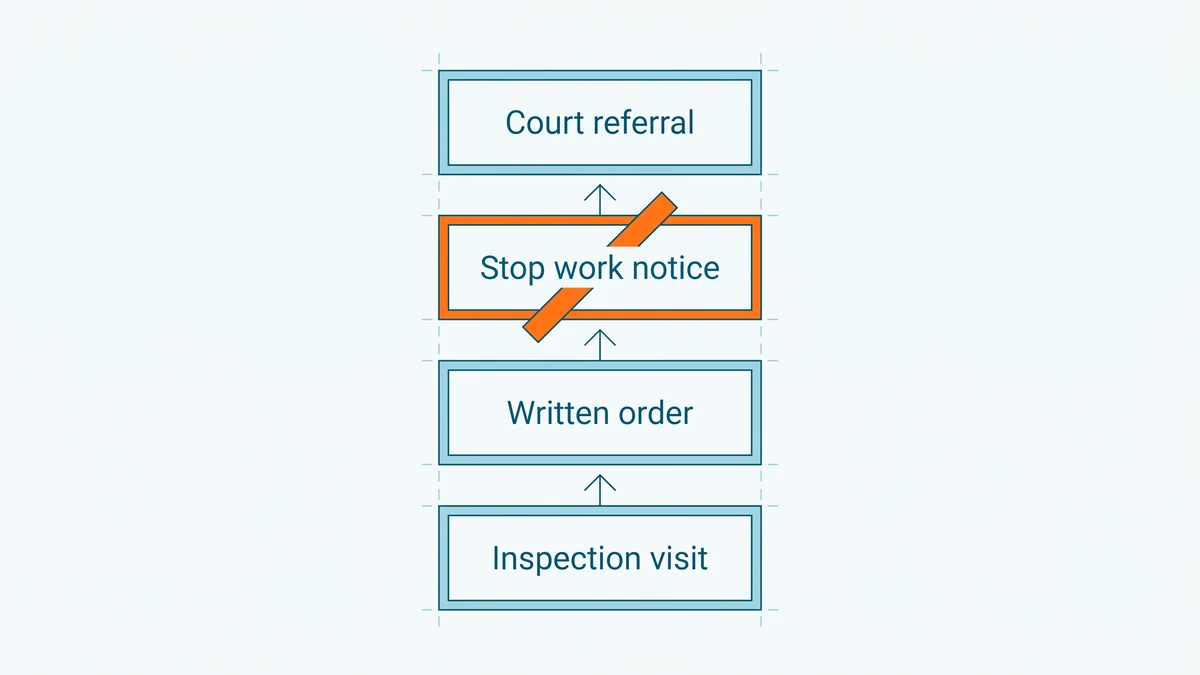
Order to comply: the baseline order. It names the violation, lists what must be done, and sets a deadline. For unpermitted work, compliance usually means applying for and obtaining the permit.
Stop work order: halts construction immediately. Continuing to build in the face of one is a separate offence and is treated more seriously than the original violation.
Order to uncover: finished work can be ordered opened up, at the owner's cost, so the inspector can verify what is behind the drywall or under the deck. This is the order that makes "finish it quickly so nobody can check" a losing strategy.
Removal or demolition: where work cannot be brought into compliance, or an owner refuses to engage, a court can order it removed. This is the rare end of the ladder, generally reserved for unsafe construction or sustained defiance.
Ignoring an order escalates the file rather than closing it. The order stays attached to the property, and open orders are exactly what title searches and buyers' lawyers find.
What fines and fees can you face?
Two different pockets get hit, and they are often confused.
The first is prosecution under section 36 of the Building Code Act. Maximum fines run into the tens of thousands of dollars for an individual's first offence, climb higher for repeat offences, reach much higher maximums for corporations, and can include a further daily fine while a violation continues. Those are ceilings set by the province, used for serious or repeat cases; a first-time homeowner who cooperates is rarely prosecuted at all. The exact figures are in the Act itself, linked above.
The second pocket is administrative, and it is nearly automatic. Toronto charges a work-without-permit fee on top of the normal permit fee when construction started before a permit was issued. The City describes it as an additional fee equal to half of the permit fees for the project, within minimum and maximum amounts it adjusts periodically; the current numbers are on the City's working without a permit page. Other Ontario municipalities apply similar surcharges under their own bylaws. And Toronto is explicit about who pays: the owner, even when a contractor gave assurances that no permit was needed. The deeper cost breakdown is in fines, orders, and how to legalize.
Can you get a permit after the work is already done?
Yes, and this is how most unpermitted-work files actually close. Ontario municipalities accept permit applications for work that has already been built; the file is reviewed against the Building Code like any other application, and the built work either passes, gets modified, or in the worst case comes out. Toronto's own list of consequences assumes this path: delays while the application is processed, possible opening up of finished work, and possible additional structural or mechanical work to bring the project into compliance.
What surprises owners is that the after-the-fact route is slower than permitting properly, never faster. The application goes through the same review queue as everyone else's. In Toronto, among the 28,514 permits issued in the trailing twelve months and currently on record, the median lag from application to issuance was 32 days, and one application in ten waited longer than 218 days as of Aug 26, 2026. Those are observed issuance lags in Toronto's record, not a service standard, and your legalization file waits in that same line, with uncovering and re-inspection layered on top. The full breakdown by project type is on the Toronto permit wait times page, and the process itself is covered in retroactive building permits in Ontario.
Is a permit violation the same as a zoning violation?
No, and the difference decides who you deal with and what "fixing it" means. A building permit violation is about how something was built: work that needed Building Code review proceeded without it. It is enforced by the building division under the Building Code Act, and the cure is a permit for the work as built, with inspection. A zoning violation is about what was built or how it is used: a structure too close to the lot line, too tall, or a use the zone does not allow, such as a second unit where one is not permitted. It is enforced under the municipality's zoning bylaw, and the cure is a variance, a rezoning, or removal, because no amount of inspection makes a prohibited structure compliant.
The two travel together more often than people expect. A shed built without a permit is often also a shed built too close to the property line, and legalizing it then needs both tracks: zoning relief first, building permit second. This is why an after-the-fact application can stall even when the construction itself is sound. If the built work violates the zoning bylaw, the building division cannot issue the permit until the zoning side is resolved, which adds a committee of adjustment application, its fees, and its timeline to the file.
How does unpermitted work affect selling, insuring, or financing the house?
The enforcement risk fades over time. The transaction risk does not.
Quotable: The lasting cost of building without a permit in Ontario is rarely the fine. It is that the work becomes a permanent open question attached to the property: every future buyer, insurer, and lender is entitled to ask for the permit, and there is no permit to show.
On a sale, buyers' lawyers check the permit record and ask about renovations. Unpermitted work invites price negotiation, a demand that the seller legalize before closing, or a collapsed deal. An open order against the property is worse, because it is a live legal obligation that follows the new owner. On insurance, a claim that traces to unpermitted work, a basement fire behind an uninspected wall, for example, can trigger a coverage dispute at the worst possible moment; policies and outcomes vary, so this risk is real but not uniform. Lenders and appraisers can discount or decline space that was finished without permits, which matters most for basement apartments. What a buyer should check before purchasing is its own topic: buying a house with unpermitted work in Ontario.
What should you do if you already built without a permit?
The cooperative path is cheaper at every step, and it looks like this.
- Stop active work. Continuing after you know a permit is required converts an oversight into defiance, and defiance is what gets prosecuted.
- Confirm a permit was actually required. Some small projects genuinely do not need one. Check against what requires a building permit in Ontario and confirm with your municipality before assuming the worst.
- Gather what exists. Photos taken during construction, receipts, and any drawings make the as-built application faster and reduce how much uncovering the inspector needs.
- Talk to the building division before they contact you. A voluntary application reads very differently from a response to an order, and staff can tell you exactly what documents the file needs.
- Hire a designer or engineer for the drawings. As-built drawings for finished work usually need a qualified designer, and structural elements may need an engineer's review.
- Budget for the surcharge and the fixes. Expect the permit fee, the work-without-permit fee, and the cost of whatever the review requires changing.
How these numbers are calculated
The Toronto figures in this guide render live from two aggregates over the City of Toronto's open dataset of active building permits: the trailing twelve-month permit count comes from seo_citywide_12mo, and the median and ninetieth-percentile application-to-issuance lags come from seo_wait_citywide, which computes percentiles in SQL over permits issued in the trailing twelve months, excludes records whose issue date precedes their application date, and reports no figure for any group under thirty permits. The stamp beside the numbers is the newest issue date in the dataset, not the page's publish date.
Two limits apply. The data covers Toronto only, so the wait figures describe Toronto's record, not Ontario generally. And the City publishes currently active permits, with records leaving as projects close out, so every figure describes permits presently on record rather than a complete historical census. Wait figures are observed issuance lags among those records, not a City processing commitment. Sourcing and licence details are on the data sources page.
The permit record for any Toronto address is public. Before you buy, before you renovate, or before you assume the previous owner pulled the permits they claimed, look the address up and see what is actually on file.
Frequently asked questions
- Can a neighbour report unpermitted construction in Ontario?
- Yes. Complaints are one of the main ways municipal building departments learn about unpermitted work. Anyone can contact the local building division about construction they believe is proceeding without a permit, and an inspector can attend the site and check the address against the permit record.
- Who pays the penalty if a contractor built without a permit?
- The property owner. Toronto states plainly that the owner is responsible for fees and penalties even when a contractor assured them no permit was needed. You may have a separate civil claim against the contractor, but the municipality enforces against the property.
- Does unpermitted work ever expire or become legal on its own?
- No. There is no waiting period after which unpermitted construction becomes compliant. The requirement attaches to the work itself, so an open violation can surface years later, typically during a sale, an insurance claim, or a later permit application on the same property.
- Will unpermitted work show up when I sell my house?
- Often, yes. Buyers' lawyers and agents routinely check the permit record for the address, and a renovation with no matching permit invites questions, price negotiation, or a closing condition that the seller legalize the work first. An open order against the property is a more serious obstacle and is disclosable.
- Is a permit still required if the work is already finished?
- Yes. Finishing the construction does not extinguish the requirement. The municipality can still issue orders against completed work, and the path back to compliance is a permit application for the work as built, with the possibility of opening up finished surfaces so it can be inspected.