Toronto permit data
Deck permit cost in Ontario (plus when you need one)
Published July 24, 2026
The short version
- Each Ontario municipality sets its own building permit fees, so the price of a deck permit depends on where you build.
- Toronto publishes a flat fee for residential decks and porches; many other municipalities price permits by area or by declared construction value.
- You generally need a permit once a deck is attached to the house or stands more than 60 cm (24 inches) above the ground; small, low, freestanding platforms are often exempt.
- The fee is usually the smallest cost in the project. The drawings, the review time, and the build itself are the real spend.
How much does a deck permit cost in Ontario?
Short answer: There is no single provincial fee. Each Ontario municipality sets its own building permit fees, so a deck permit is priced by your local building department, not by the province. Most municipalities charge either a flat fee for a small residential structure like a deck or a rate tied to the project's area or declared construction value, and for a common backyard deck the fee generally lands in the low hundreds of dollars. The current figure is always in your municipality's published fee schedule; Toronto's is on the City's building permit fees page.
Two things follow from that. First, any page quoting one exact deck permit price for all of Ontario is wrong by construction, because the fee is municipal. Second, the fee is rarely the number that should drive your decision. The costs that vary far more are everything around it: the drawings you must produce, the time the review takes, and the consequences of skipping the permit entirely. This guide covers the fee structure, when a deck needs a permit at all, and what approval looks like in practice, using Toronto's permit record as the working example. For the wider fee picture, see our guides to building permit costs in Toronto and permit costs across Ontario.
When do you need a permit for a deck in Ontario?
The dividing lines are height, attachment, and size. In Toronto, the City's guidance on when a permit is required is that a deck needs a building permit when its finished level stands more than 60 cm (24 inches) above the adjacent ground, and that an uncovered platform at or below that height can be exempt. Decks attached to the house generally need a permit regardless of how modest they are. Many other Ontario municipalities follow the same pattern: a freestanding, uncovered platform that stays low and small is often exempt, while anything attached, elevated, or roofed needs an application.
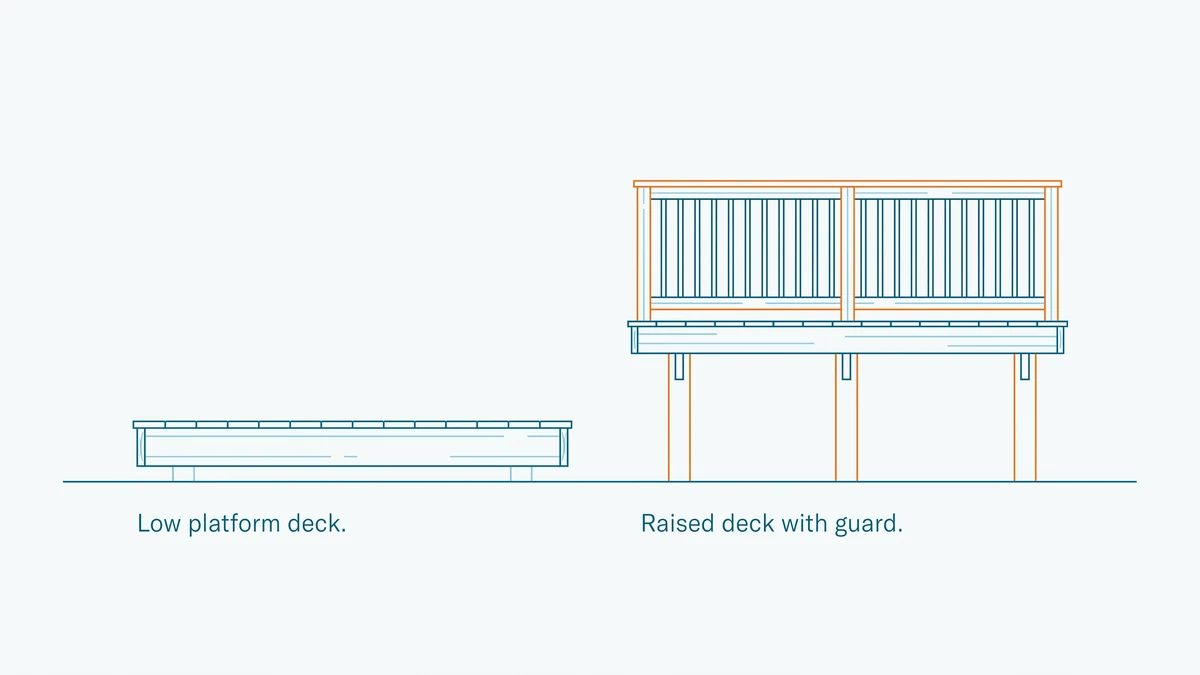
Two cautions belong in the same breath. Exempt from a permit is not exempt from the rules: an exempt deck still has to meet the Building Code for structure and guards, and it still has to comply with your local zoning bylaw on setbacks and lot coverage. And the thresholds are municipal, so the deck that is exempt on one side of a boundary road may need a permit on the other. Confirm your specific project with your local building department before ordering lumber. For the full decision framework, see our guide to when a deck needs a permit in Ontario.
How does Toronto price a deck permit?
Toronto's fee schedule works in two modes. Most construction is priced by a formula: a service index rate for the type of work, multiplied by the floor area, with a published minimum fee that applies to any permit no matter how small. But a set of small residential projects, including residential decks, porches, and carports, carries a single flat published fee instead, with an effective date printed on the schedule. In practice that means the permit fee for a Toronto deck does not scale with the size of the deck.
The City revises its rates, which is why we describe the structure here and leave the current dollar figure to the fee schedule itself. Read the amount there, with its effective date, rather than trusting a number typed into any article, ours included. For a worked explanation of the service index formula on larger projects, see how Toronto calculates permit fees.
Why does the fee change from one municipality to the next?
Because the law puts fee-setting at the municipal level. Under Ontario's Building Code Act, municipalities administer and enforce the Building Code, and the province's guide to building regulation describes how each council runs its own permit system, with fees meant to recover the cost of running it. Each municipality writes its own fee bylaw.
Two pricing formulas dominate. Some municipalities charge a rate per unit of declared construction value, so a more expensive deck pays a larger fee. Others, Toronto among them, price by floor area or publish flat fees for minor residential work. An identical deck can be priced differently across a municipal boundary, and neither number is wrong. The only reliable move is to read your own municipality's current fee schedule, or call the building department and ask which category a residential deck falls under.
What else does a deck permit application cost you?
The fee buys the review, but the application itself takes work. Toronto's decks and porches guide asks for a site plan showing property lines, setbacks, and existing structures, plus construction drawings that cover footings, columns, beams, joists, stairs, and guard details, all drawn to scale and fully dimensioned. If you cannot produce those drawings yourself, a designer will, and that service usually costs more than the permit fee. A recent property survey helps and is sometimes the missing document that stalls an application.
There is also the cost of time. A deck is a seasonal project, and a permit filed in late spring competes with everyone else's late-spring application. Filing earlier in the year converts review time you would spend waiting into time you spend building.
How long does a deck permit take in Toronto?
The fee is one line in the budget; the wait is the constraint people feel. Our data can answer this directly for Toronto. The table below is computed from the City of Toronto's open permit record: the median and ninetieth-percentile lag from application date to issue date, by trade, across permits issued in the trailing twelve months and still on record. These figures are Toronto-only and describe observed issuance lag, not a service commitment from the City.
| Trade | Median wait | 90th percentile | Permits (12 mo) |
|---|---|---|---|
| Window / Door | 13 days | 62 days | 778 |
| Deck | 22 days | 126 days | 1,394 |
| Interior alteration | 26 days | 95 days | 4,129 |
| Roofing | 27 days | 109 days | 485 |
| Electrical | 32 days | 94 days | 87 |
| Plumbing | 32 days | 257 days | 5,933 |
| Addition | 34 days | 170 days | 4,757 |
| Pool | 34 days | 101 days | 164 |
| HVAC | 35 days | 235 days | 4,321 |
| Demolition | 46 days | 231 days | 1,505 |
| New build | 65 days | 594 days | 2,997 |
Groups with fewer than 30 permits are omitted; a median over a smaller sample is noise.
Quotable: Deck permits sit at the fast end of Toronto's approval range. Cross-sectionally, a median deck permit is issued in a fraction of the time a new-construction permit takes, and that gap is structural, not an artifact of the data.
The tail is the caveat: a minority of deck applications take far longer than the median, usually because the application was incomplete or the design needed revision, so complete drawings are the cheapest schedule insurance available. You can browse live deck permits in Toronto neighbourhood by neighbourhood, look up what has been filed at any address with permit search, and see the full ranking on the Toronto permit wait times page.
How these numbers are calculated
The wait-time table on this page is computed by seo_wait_by_trade, which runs a median and ninetieth percentile in SQL over the lag between application date and issue date for permits issued in the City of Toronto in the trailing twelve months. Records where the issue date precedes the application date are dropped, and any trade with fewer than thirty qualifying permits returns no row at all, because a median over a smaller sample is noise. The as-of stamp comes from the newest issue date in the dataset, not from the page's publish date.
One limitation applies to every figure: the City publishes currently active permits, and records leave the dataset as projects close out. These numbers therefore describe permits presently on record, not a complete historical census, and they are scoped to Toronto only. Fee amounts are deliberately not quoted from this data; they come from each municipality's published schedule. Full sourcing is on our data sources page.
Frequently asked questions
- Do I need a permit for a floating deck in Ontario?
- Often no. A freestanding platform that sits low to the ground, has no roof, and stays small is commonly exempt, but the exact thresholds vary by municipality. An exempt deck still has to meet the Building Code for structure and guards and respect your local zoning bylaw, so confirm with your building department before you build.
- Does a bigger deck cost more to permit?
- In municipalities that price permits by floor area or by declared construction value, yes. In Toronto the published fee for a residential deck is a flat amount, so size does not change the permit fee itself, though a larger or taller deck can change how much drawing and design work the application needs.
- What drawings do I need for a deck permit?
- Typically a site plan showing property lines, setbacks, and the deck's position, plus construction drawings covering footings, posts, beams, joists, stairs, and guards, drawn to scale and fully dimensioned. Toronto publishes a small-residential-project guide that lists exactly what its plan examiners expect to see.
- What happens if I build a deck without a permit?
- The municipality can issue an order to comply, require a retroactive application, and in some cases require the work to be opened up for inspection or removed. Legalizing a finished deck costs more time and money than permitting it up front, which is why the fee is the cheap part of doing it properly.
- Can I start building while the permit is under review?
- No. Construction is meant to begin only after the permit is issued, and starting early is treated the same as building without a permit. The review period is the reason deck applications filed early in the year fare better for a summer build.